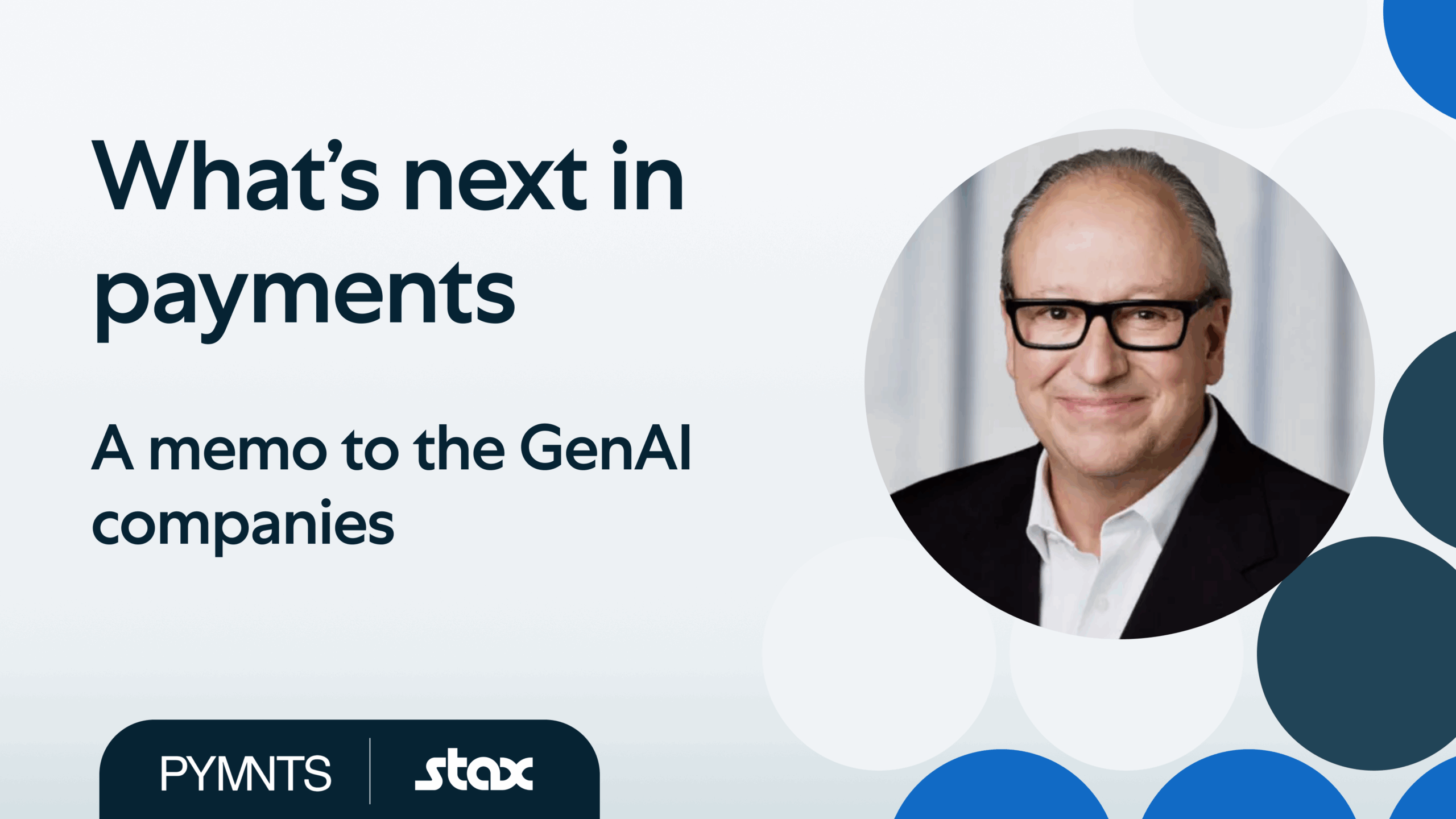
Hi, everyone. I’m John Gaffney, and this is What’s Next in Payments. It’s our monthly series that asks senior executives from leading firms to weigh in on an urgent topic in the payments banking and digital economy. This month we’re doing for what’s next in payments, memo to the Gen AI companies. You know, Gen AI companies are locked in a battle for developing and delivering AI models that will stand the test of maybe the next month or the next quarter. But we know that the banking and payments business can’t work like that. So we’re going to cover three things today, perceptions of what has been accomplished so far with GenAI, what companies are currently using you for, and most importantly, if they could talk to one of the CEOs of one of these major AI companies, what would they ask them to design? Here to discuss this issue and give us a sneak peek at his requests is Mark Sun, Chief Technology Officer at Stax Payments. And before I introduce and welcome Mark, a little background on Stax Payments. It is a comprehensive payment technology company that offers an innovative approach to merchant services, particularly well suited for high volume businesses and software platforms. Okay, Mark, now I can say welcome. Hey, John, thanks for having me. Yeah, we’re very excited to have you. This is our first of the month. So you’re our test case here and I’m really looking forward to it. So Mark, let’s zoom out a little bit. How has Geni played in the Stax payments ecosystem and their customer experiences? Have you observed any tangible benefits from it yet? So thanks, John. I think as we think about how we adopt the technology at Stax, there’s really three areas that we would focus on. Kind of the things that I think a lot of customers or a lot of our, probably our peers or competitors are also thinking about, how do we actually service our customers using this technology to make our customer service more effective and more efficient? And how do we get to the root of any incident or issues that might come up through a customer service interaction? The second one is how do we use the technology internally, one for our business users, and how do we become more efficient in the business processes and our day to day operations or business as usual as we’d like to talk about it. And the third one is, how do we actually improve the lives of our developers? How do we increase their productivity? How do we make our code better, stronger, faster? I think we’ve got a philosophy of make it work, make it work better and then make it work cheaper. So I think in all three of those areas, we’re trying to make sure that we’re using the technologies available to us in a cost effective and safe manner. And I think those are points that a lot of people failed to talk about now that I’d love to share with you during this conversation. Yeah, let’s do that now then. So safe, safe, and I can’t remember the other word you used, but you certainly set up my next question here. Let’s talk Yeah, about absolutely. Safety and cost, who doesn’t like So those two certainly the security folks at Stax are constantly thinking about that, and our attorneys are thinking about that, right? You think about how do we actually set up guardrails around using this technology in such a way that we’re not proliferating data out into the atmosphere in a way that is unintentional. And every service or every application we use, especially all the software as a service utilities we have, have AI embedded. It’s almost this thing hoping to have this, we’re going to have a really good sandbox and we’re going to control who’s acting where and what we’re connecting to. But the reality of it is there’s hardly a service we have now that doesn’t have an AI component that’s taking your data and maybe training on that data. And what are the unintended consequences of doing those types of things? And it’s this kind of like what happens with Apple intelligence? We know what their privacy policies are, we’re tracking these things, but everybody know that. And are there other applications or what are people doing or partners doing with that data? So governance and setting up guardrails has been a really kind of the first thing we’re trying to achieve with our AI strategy internally and with our customers and with our external vendors. So governance is something I’d love to talk about. And then cost, the models, we’ll talk about this a little bit more, I hope, is that we’ve done everything but the kitchen sink model. I love how people like to say large language models. I want effective language models. In fact, I stopped saying large, I just say language models because the bigger the model, the kitchen sink model, I think everybody’s figuring out that being a mile wide and an inch deep is useless because the second or third question you ask is like, sorry, I don’t have that answer. And then what do you do then you hit zero operator, like right now, get me to an operator. So the utility of these super large models where we were trying to solve every problem in a single model, I think people are coming to the conclusion they’re expensive and the utility of those models can be quickly dismissed just through interaction people are having with them. So as the CTO of Stax though, Mark, there’s got to be some things that excite you about AI. What are some of the applications that you are excited about? Yeah, absolutely. I do think there are business problems that can be solved. So as we think about moving from these large monolithic models to agentic models, so people are talking about how do we solve solutions with smaller agents. And in fact, I always say like, what’s the smallest agent we can build has the lowest inference costs? So CFOs love that low cost, and we can do a lot more with them. So smaller models that are coordinated and orchestrated to solve really pointed problems. So my favorite one is, and we tested this, done the super big models and we had everything you could possibly know about all the credit card providers that are out there. And the utility of that model was okay. But the questions I get from customers are like, how do I configure my terminal and what’s wrong with it? Trying to like solve a problem like I’ve got X terminal, how do I configure it in such a way that I’m getting the best interchange possible, I’m getting the fastest feedback or response times possible and solving that problem be super specific and super deep. But there might be other issues and you could put that kind of stuff into a standard rules engine, nothing new there. But wouldn’t you want to check like, Hey, is that merchant, have they paid their subscription? Hey, you might want to have an agent go out and check and think, are they current? Who checks whether they’re actually a customer or not still, or if their service got turned off? Or it used to be the old question like, Is your computer plugged in? That was always the first question. People would ask, Is your computer plugged in? It’s like, Well, have you paid your bill? Might’ve been turned off. Let’s check on that. And then let’s talk about how quickly the terminal’s responding. And I think that’s where you’re getting these really specific steps. Like agentic models will allow us to work through the problem and use the appropriate AI model to solve the problem that could be dynamic. So it’s not just as you got to do A and then you press B and then you get to C, these flows could be a lot more dynamic. And that’s super exciting because it’s almost the same analogy we have is moving from these big monolithic mainframe applications to distributed computing to cloud applications. And we’re taking that same trajectory around building out AI language models now and AI solutions. And there’s a lot of exciting things that are happening with this agentic kind of pivot that everybody is making. It’d be interesting to see as you’re doing these discussions if others are feeling the same thing. Yeah, I couldn’t agree with you more. When I saw that NVIDIA introduced a $3,000 laptop, I was like, oh, okay, that’s where we’re going now. What a trillion transistor or something. I think it was a trillion, wasn’t it? Unbelievable. It unbelievable. Yeah. So small small… You know, models at the edge will be important. Efficient language models. Yeah. Yeah. Yeah. Absolutely. Absolutely. But, you know, certainly governance, cost, utility, have to be the three points of the triangle you’re trying to balance. I actually spun up a really big language model, and I won’t say who we put it on, the service we put it on, but literally to do Hello World was $1,800 a month. And for some customers, that might not be that big of a deal. But to have zero utility at $1,800 a month, I was like, Well, that could be a little bit expensive. But we just have the same thing in another one of the cloud providers, and it was $180 a month actually fully loaded, like actually with the vector database populated and actually doing inference against it. So, it’s interesting to see the difference of kind of what’s out there. And we’re gonna have to build these solutions in the most cost effective smallest language model possible just to reduce inference costs as we move forward, or these things will never scale. Yeah, so you’ve given us some great, I love the way this conversation’s going. You’ve given us some great stuff so far. And I’m wondering if that would inform if you had Sam Altman or for a conversation, would it be those three points, the three points of the triangle that you would tell them about? Yeah. You know, I think that, you know, kind of moving forward, you know, you kind of think about, you know, how do you move these models forward? You know, I like to point out, you know, my mother wrote her master’s thesis 1987 on artificial intelligence. It was all about this stuff’s been around for a long time. So, you know, we’ve been doing rules engines, and she constantly tells me now, it’s like, we didn’t have the computing power you have today. You know, the computing power that you have today actually enabled these things to come to fruition. But at the end of the day, we’re still doing kind of this probabilistic statistics type of thing as to what’s the next word you might say. And it’s great for summarization and categorization and some of these data science things. But I think that really the next big leap, I think I’ll say, Sam Altman talks about it, is reasoning. How do we actually reason? Like how do we actually come to some conclusion with a more complete picture of the data or to fill in the blanks? Or Sometimes there’s kind of this leap of faith that we make as humans to make a decision that how do we get systems to be able to do that? And it’s information that might be determined and information that might not be deterministic, or it might be in a gray area, or how do you make decisions with incomplete information is something that humans do really well, and how do we actually get the systems to do that? So it’s just like, it’s not a, they have this, do that. You know, they have this, do that. And that will be, I think, an interesting leap on who’s going to come up with reasoning first. Interesting. So you mentioned fraud detection and, you know, I’ve read a lot and we’ve heard a lot from people about the effectiveness of AI and risk management. Is that something you see as a positive here and what other capabilities would you like to see developed? Yeah, know there’s lots of dimensions when we start talking about risk management and certainly within the credit card space, you’re doing fraud at scale is something that our partners do and credit card issuers can find in spot fraudulent transactions. So people have to realize that that’s kind of the problem of the issuer. As a processor acquirer, I represent the merchants who accept credit cards. So my big risk and fraud exposure is the merchants we bring on board. And we have to go through a vetting process and using AI to go through that vetting process, I think, is going to… We’re using a few tools, but it’s going to help us a lot more in the future. I also think it takes this agentic approach. So let me give you an example. One of the things we need to make sure is everybody has a banking relationship. And determining whether you have a banking relationship, it’s kind of a binary thing, is it there or is it not? But how can you determine other attributes of having that relationship? How long have you been there? What’s the balance? What’s been the available balance? I mean, what are the things that we can do to kind of enrichen the decision process around, yeah, you have a relationship with a bank, is it brand new? Why is it brand new? Because that’s where fraud comes in to play with us, is that merchants will be set up overnight. They might have a banking relationship. It might be temporal. It could be flighting. And so you’ve got to find that. Do they have a storefront? Like how long have they had a storefront? Do they have a website? So there’s all these little things we go through these checks on that a smart person could set up pretty quickly. And it’s getting to like, Hey, they’ve only had a website for a couple of days. They’ve only had a banking relationship for a couple of days. That’s the stuff where red flags are flying everywhere. You can spot those. But if they’ve had an established banking relationship and they’ve had a website for a while, what’s their financial condition? Are there other attributes we should be vetting? So fraud with regard to merchant onboarding is kind of where we focus a lot of our efforts. And then also making sure there is transactional fraud that we have to check for, but it tends to be on the settlement side of the house. And there are some big red flags around that that are also interesting. You’ll see people that have thousands of dollars a transaction within a batch, and then they’ll have the entire batch will be reversed in a credit. Like, those are really suspicious, you know, where you’ve got transactions that are being actually done on one credit card and the refund is done on a different credit card. Those are super suspicious, and those are the things that we have to catch. And there’s a lot of that that happens or merchants that are, doing large transactions on their own personal credit cards. Big, huge red flags where people are, like, trying to use cash, you know, trying to basically create some cash. So so there’s there’s merchant onboarding and there’s transactional settlement fraud that we focus on. Probably the most, it would be our highest level of focus. The card brands themselves do a lot with regard to transactional fraud in preventing transactions from going through and because it’s crazy amounts or things like that. So we use partners and we have some internal systems is kind of the way I would categorize this. Okay, excellent. Very well said. So we hear a lot about customer engagement and AI, and I think that’s in the context of agentic AI. Is that the killer app here for customer engagement? I think a lot of people will talk about hyper focus or hyper personalization or how do you get down to the details so you’re not just a customer at a certain threshold or in a certain category. I do think this really speaks to… It’s a little bit opposite of my large language model. Most of the language models we built today are based on static information. So we have basically just dynamic put in PDFs or you put in data. I’m starting to see now that people that… I’m sorry, me back up a second here. The people will talk about putting data within a language model, and there’s actually this thing called a context window. A context window is how many documents you could add to the model. So if you use something like the Google Notebook LM, you can put 50 documents in that tool and it’ll search their large language model and augment it with your context model, the data you put in. They don’t train on that, so it’s actually kind of really cool thing. But now we’re talking about having infinite context windows where we can actually connect relational data into the artificial intelligence into the large language model or language model so that we can start propagating actually querying data. And I’m really excited about that because we haven’t really made that transition to relational data augmenting our models yet. But that’ll kind of be the thing that I think will give us that hyper personalization on the customer service front. We’re not there yet. We’re working with our CRM partner on offerings that they have to basically enrich the customer service interaction with our customers during calls. But I see some great opportunities here moving forward. Hopefully other people do too. The hyper personalization thing I think could be facilitated using these agentic technologies. Mark, last question for you. Do you feel like the Gen AI companies or just the AI companies, maybe for better, do you think they need to do a better job understanding the banking and payments industry? Do you think they need to align this quick update cycle with what the banking and payments industry needs? Yeah, I think the things we’d be looking for within the financial industry in general, Gen A are the large AI providers, is that we need transparency, we need to make sure that we understand kind of where our data is going, so the privacy concerns and making sure that people aren’t training on our data, just making those things clear. I think that there are some providers who literally tell you that we’re not going to train in your data And they tell you, like in the developer instance, they tell you how to turn off tools or parts of Visual Studio Code so that no one can see and train on your data. So there’s some really exciting things happening in the Gen AI space or just a language model space around development and making sure that your code is in a proprietary container. And I also think just making sure we understand, it’s called derivative works, but you can say that my work, the data I just gave you isn’t going to be trained on, but if somebody takes a summary of my data, are you doing something with derivative works of my data? So there’s a slurry slope as to where does my data end? Like where does your privacy statement end? And are you summarizing my data? And is that being covered within our privacy and security policies? So there are guardrails around derivative works and where does that derivative work go? And it could be statistical analysis or there could be data, it’s probably not identifiable, but it’d be good to know where is that data going? And just give me that transparency. If you’re gonna use the data in some statistical sense, that’s great, just let me know it because that could be very valuable to people over time and it might not be caught within a standard privacy policy. Wow, masterclass in AI right there. Thank you so much, Mark. Was excellent. That’s going to do it for this episode of Payments TV. My name is John Gaffney. My guest has been Mark Sunt, who is the chief technology officer of Stax Payments. Mark, thanks for a great session. Thanks so much, John. And thanks to everybody who listened to this this session. Thanks for your time.