Business growth is exciting, but it also creates complexity, especially with payments. As businesses expand across multiple stores, sales channels, and customer touch points, managing transactions becomes a juggling act.
An integrated payment platform brings order to the chaos by unifying systems, streamlining operations, and unlocking insights. Read on to learn how.
TL;DR
- Growing businesses face payment complexity across stores, channels, and systems—an integrated payment platform streamlines the entire payment process.
- Integrated payments reduce manual data entry and human error while syncing with ERP, accounting software, and point of sale systems.
- Key features to look for: seamless integration, support for multiple payment methods, transparent pricing, real-time data, scalability, and reliable support.
What is an integrated payment platform?
An integrated payment platform is a single solution that connects your sales, accounting, and business systems to simplify how you accept payments. Instead of juggling multiple tools, integrated payment technology lets you process payments, capture transaction data, and reconcile records automatically.
Integrated payment platforms can reduce manual data entry and human error, so you can streamline operations and boost customer satisfaction.
What to look for in an integrated payment platform
Not all payment solutions are created equal. Here’s what to prioritize when choosing the right integrated payments solution for your business.
Seamless integration with your existing systems
An integrated payment platform should connect smoothly with your current software. For many businesses, this includes:
- ERP system
- Accounting software
- Point of sale
- Ecommerce platform
When data flows smoothly between tools, manual data entry is eliminated and the likelihood of mistakes is reduced, making your processes more efficient.
Support for multiple payment methods
Customers expect to pay using their preferred payment method which is often credit and debit cards, contactless payments, or online payments through mobile apps. An integrated payment system ensures you can process payments securely, whether in-store or online, without juggling multiple providers. The right integrated solution gives you a complete suite of payment acceptance options while streamlining operations in the background.
Transparent pricing and low processing fees
Payment processing should be simple, not full of hidden costs. Look for an integrated payment solution with clear, upfront pricing.
For example, Stax Pay offers subscription-style pricing that eliminates percentage markups, ensuring you only pay a flat monthly fee plus direct interchange. This model can significantly reduce processing fees for growing businesses while providing predictable costs.
Real-time access to payment data and insights
The right integrated payment processing solution doesn’t just help you complete transactions—it helps you make smarter decisions. With immediate access to transaction data and customer behavior insights, you can spot trends, optimize cash flow, and refine your customer experience.
Look for platforms that embed reporting and analytics directly into your business operations. From mobile apps to cloud-based dashboards, having visibility into your entire payment system drives better decisions and long-term growth.
Scalability to match business growth
Your payment platform should grow as you do. Integrated payment systems are designed to handle increasing transaction volumes, multiple locations, and new sales channels without adding complexity. Whether you’re expanding to new stores, adopting embedded payments, or layering in advanced integrations with enterprise resource planning tools, scalability ensures your payment system never holds you back.
Reliable support from your payment provider
Even the most advanced integrated payment solution is only as strong as the support behind it. Look for a provider that offers responsive, knowledgeable customer support whenever you need it. A partner who understands payment processing, PCI compliance, and integrations with various systems can help you resolve issues quickly and keep your operations running smoothly.
Not only that, but reliable support gives you peace of mind and ensures that your payment acceptance process continues to deliver the best possible customer experience.
How to implement an integrated payments platform
Rolling out an integrated payment system doesn’t have to be overwhelming. Follow these steps to streamline payment processing and set your business up for long-term success.
Assess your current payment systems and workflows
Before introducing new payment technology, take stock of your existing setup. Map out how you currently process payments. Is it through an in-store point of sale? Do you focus on online checkouts or mobile apps? Whatever the case, take note of how everything functions and ensure it works with your implementation process.
Also, pay attention to pain points like duplicate data entry or delayed payment reconciliation. Understanding where bottlenecks occur allows you to pinpoint issues that an integrated solution can solve.
Define business needs and customer payment preferences
Every business is different, so clarity on your priorities is key. Do you need faster access to payment data, support for multiple locations, or better insights into customer behavior?
At the same time, consider how your customers prefer to pay—credit cards, debit cards, contactless payments, or online payments. Aligning your business goals with customer expectations ensures your integrated payment platform improves both operations and customer satisfaction.
Integrate with your existing software
The power of integrated payments comes from connecting seamlessly with the systems you already rely on. From accounting processes and ERP systems to CRM or POS, integration ensures data flows smoothly across multiple systems. Whether through application programming interfaces (APIs) or pre-built software provider integrations, the goal is to create a single platform for all payment information.
Test data flows and transaction accuracy
Once integration is complete, testing is essential. Run transactions across different payment payment methods to confirm that payment acceptance works without errors. Double-check that transaction data syncs properly with your accounting software, customer records, and reporting tools. Don’t skip this step; testing upfront prevents costly mistakes later.
Train your team on the new payment processes
Even the most seamlessly integrated payment systems only work when your team knows how to use them. Provide training that covers everything from how to accept payments to handling customer payment information securely. Clear onboarding ensures employees are confident, and helps deliver a seamless customer experience.
Monitor performance and optimize over time
Regularly review payment data and historical trends to identify opportunities for improved efficiency, lower costs, or stronger customer trust. For example, monitoring processing fees or analyzing cash flow patterns can highlight areas for optimization. An integrated payment solution should enable merchants to adapt quickly, keeping business operations agile and aligned with long-term growth goals.
How the Stax integrated payment platform keeps your multi-location business organized
One of the hallmarks of a growing business is having multiple locations. And one of the biggest challenges for multi-store companies is tracking your sales and analytics. Disparate solutions can create blind spots if you can’t access your data all from one place.
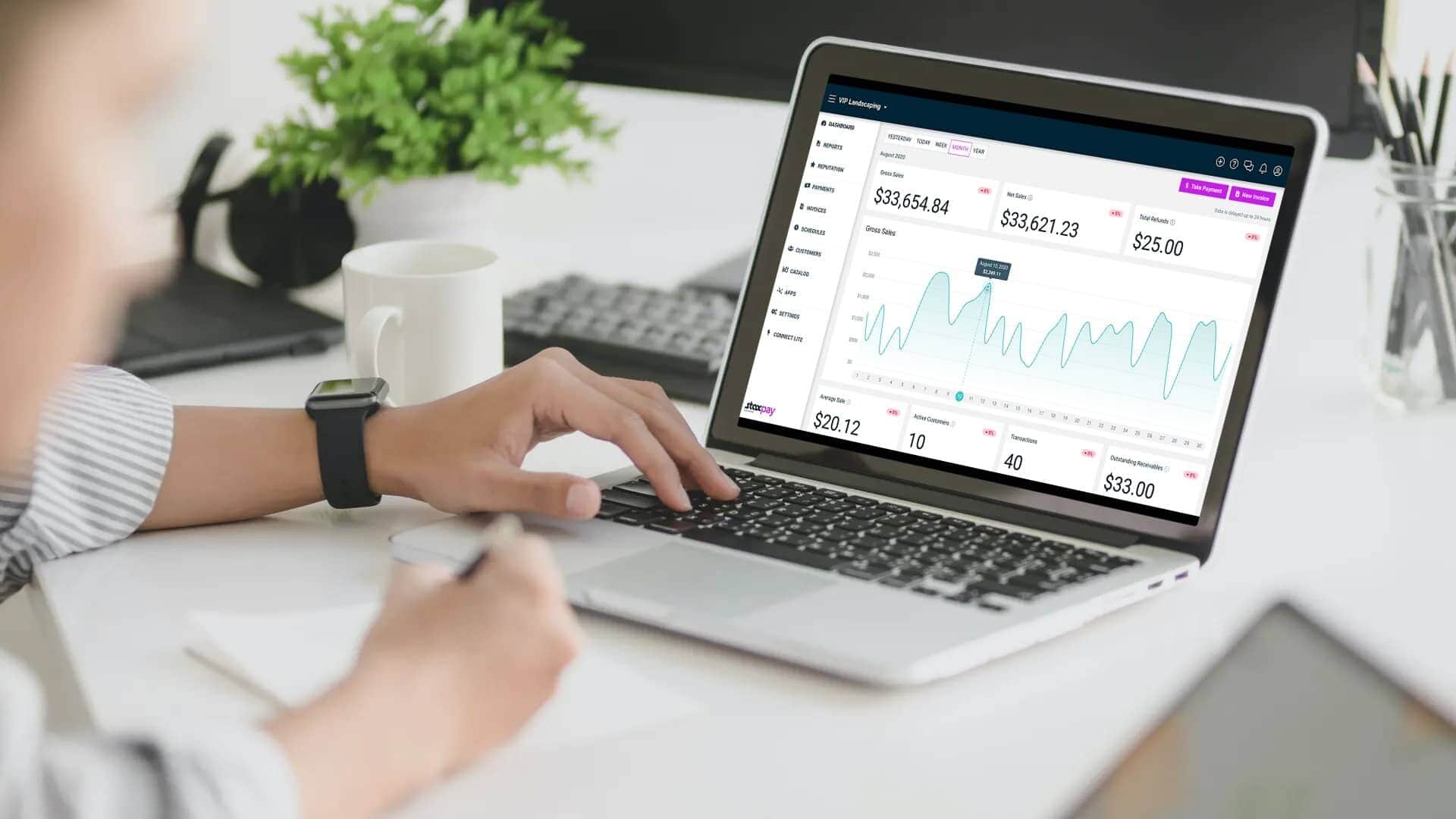
Stax integrated payment platform gathers all of your data and funnels it into one merchant dashboard. You can dig into all your locations’ sales data to see if there are any gaps you need to address.
How to take advantage of Stax’s multi-store reporting
You can track sales from different locations on the Stax platform using merchant analytics. Stax Company Overview Report will show you data from across all your solutions, while the Stax Dashboard will compile all of your locations’ data in one place. You can see sales, outstanding receivables, and deposits. This aggregated view organizes all your information, eliminating the need for reconciliation.
To access reporting, you can select the Company Overview Report form within the “Reports” tab and choose which store locations you’d like to include in the report. The system will then gather your data and present it to you in an easy-to-read dashboard. From there, you can track and manage everything from sales trends to deposit reports.
The key benefits of an integrated payment platform for multi-store businesses
An integrated payment platform like Stax will simplify how you track your sales and profits. When your sales data is in one place, you can make decisions faster so you get hours back that you can reinvest into your stores.
Multi-store reporting also streamlines how you invoice customers across your different business locations. If you’re using separate tools for invoicing and analytics, your data may not line up. This means spending extra time and effort in reconciliation. But an integrated payment platform can provide you with data from across all your locations and solutions.
This is especially great if you charge monthly memberships or offer package deals. Since you can see outstanding receivables, you can better anticipate your cash flow. You have a clear view of how all your business locations are doing.
Multi-store reporting and merchant analytics will streamline your processes or completely eliminate manual number-crunching. This integrated approach to payments provides not only data but the context behind it. You can pinpoint which of your stores you should focus on without needing countless solutions and accounts to do it.
The Stax platform doesn’t just help clarify your data—it helps you drive further growth for your business.
At Stax, we offer an array of payment processing solutions that help you take your expanding business to the next level.
Ready to see how our Stax integrated payment platform can help drive growth for your business? Reach out to Stax for a consultation today.


