SMB owners wear many hats, managing everything from staff to sales. Adding to the already tough job of managing a small or medium business (SMBs) is the complex task of understanding how payment processing works, including managing the fees, equipment, accounts payable and more.
Here’s where a payment management system (PMS) can swoop in as your financial hero to help you understand your business better.
TL;DR
- Payment management systems manage payment processing so you can accept payments, send invoices, track transactions, and view financial data.
- Look for a PMS that can serve as an all-in-one platform for payment processing, integrates with other technologies, offers appropriate POS equipment, and prioritizes security compliance.
- Government agencies have a payment management system to manage grant award payments, making the search for payment management system information more complicated.
What is a payment management system?
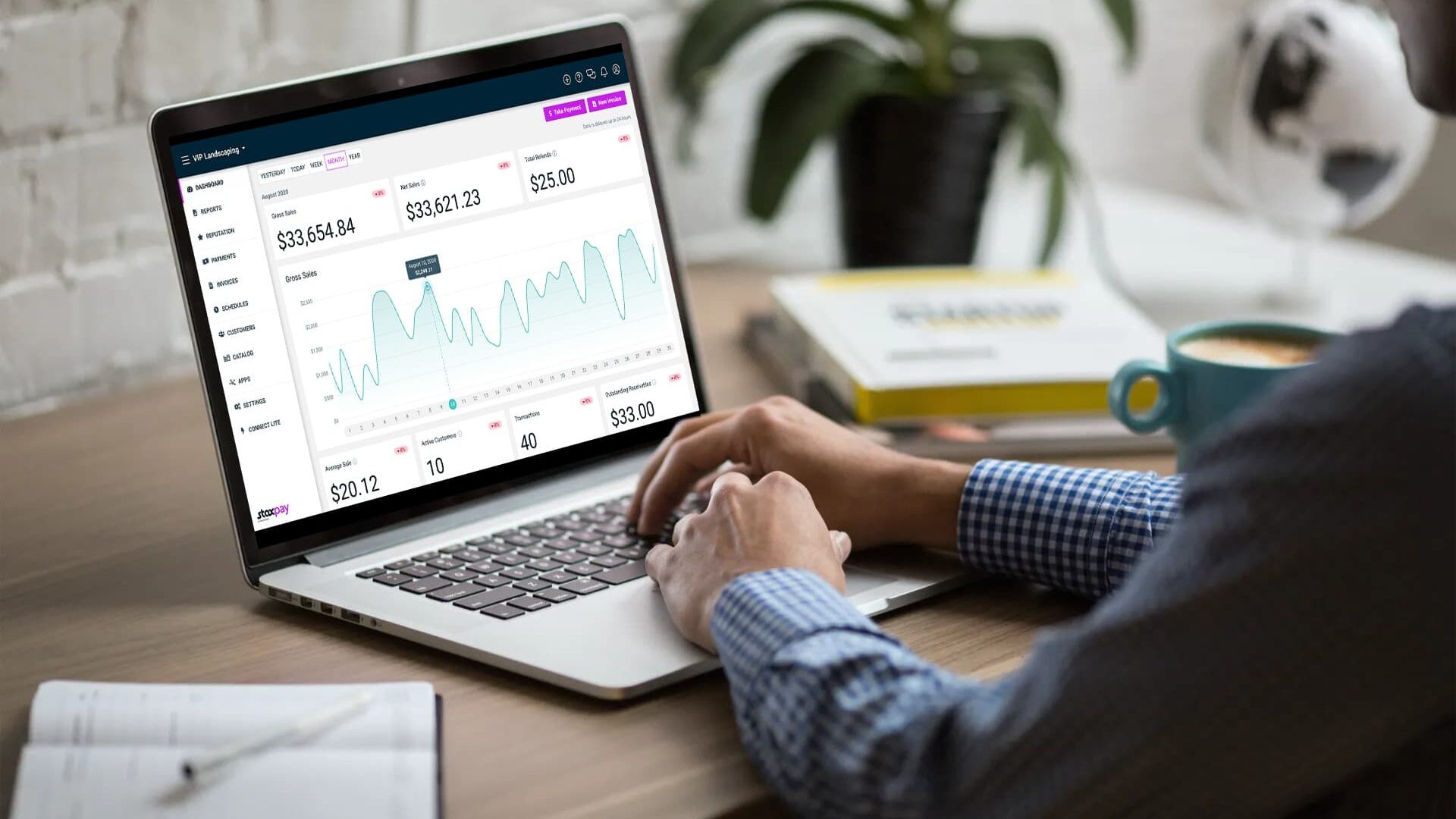
While often referred to in the industry as a payments platform or integrated payment solution, the core function of a payment management system (PMS) is customer payment acceptance and tracking. Think of a PMS as your financial command center. It consolidates all your payment processing needs into one user-friendly platform. A PMS accepts payments, sends invoices, tracks transactions, and analyzes your financial data—all in one place.
You may also hear the term cash management system (CMS), particularly from banks. A CMS is a sophisticated suite of tools focusing on the treasury, liquidity, and overall financial health of a large company. The system we’re discussing—the payment management system (PMS)—is specifically focused on the execution, reporting, and reconciliation of incoming revenue (sales) via electronic payments. While both relate to cash, the PMS is your specialized tool for customer payment acceptance and tracking.Imagine cash flow as a river—cash management oversees the whole flow, while payment management ensures water gets in and out smoothly.
Your PMS is a central hub to manage payment requests and store banking information (like your routing and bank account number for ACH payments). A comprehensive PMS is especially useful for SMBs, where efficiency is key and understanding financial performance in your business shouldn’t be overcomplicated.
Key features of a supercharged PMS
So, what exactly should a payment management system provide to your business? Key features of a well-built PMS include:
- Efficient transaction processing: Speed and accuracy are key, and a good PMS should process payments quickly and with a user-friendly interface, keeping your cash flow smooth and customers happy.
- Robust security measures: Any valuable PMS needs to have standard security features like encryption, fraud detection and compliance with industry standards, including the PCI DSS.
- Integration with other business tools: A truly modern PMS should seamlessly integrate with your existing accounting software, CRM, or inventory system. Better yet, look for a platform (like Stax) that offers many of these functions natively, reducing the number of external systems you need to connect.
- User interface and experience: Your PMS should be intuitive and easy to navigate, allowing you to focus on running your business, not wrestling with technology.
- Reporting and analytics: A good PMS provides you with reporting and analytics tools, giving you valuable insights into your revenue, customer buying trends, and payment success rates, helping you make informed decisions about pricing and product.
- Automated reconciliation: The PMS should automatically match transactions recorded in the system to the settlement deposits in your bank account. This eliminates manual tracking, reduces errors, and saves significant time during your month-end accounting close
Note: Look for advanced features that support payment orchestration, allowing you the flexibility to route transactions and manage various payment methods efficiently as your business scales internationally or diversifies its payment acceptance.
The diverse world of payment management systems
If you’re seeking to understand what payment management systems are, a quick internet search will yield some information worth explaining before we get too far into the various PMS options for SMBs.
The U.S. Department of Health and Human Services (HHS) also has a payment management system, which is a centralized grant payment system managed by the federal government. The Program Support Center for Payment Management Services (pms.psc.gov) serves as “a fiscal intermediary between federal awarding agencies and award recipients.” Also available through the HHS is the Federal Financial Report (FFR), which provides information about grant award spending, grantee information, and various disclosures.
Essentially, these federal agencies have a specific PMS to track grant award payments and payee information, ensuring federal cash disbursements are securely managed, and grant recipients can receive their awards in an auditable way.
Now, let’s break down various other terminology related to payment management systems you’ll encounter in your small or medium business:
- Merchant account providers (also known as processors or ISOs) act as the middleman between your business and the acquiring bank, facilitating the merchant account relationship that allows you to accept credit and debit cards.
- Payment gateways securely process online payments, acting as a bridge between your website and the payment processor.
- Payment processors handle the nitty-gritty of authorization, settlement, and transfer of funds between your business and your customer’s bank.
- Point-of-sale (POS) systems are the all-in-one systems you see at retail stores, handling in-person transactions and often integrating with inventory management software.
- Mobile payment systems let your customers use different payment methods like their digital wallets, contactless card payments and more, offering a convenient and secure way to accept payments on the go.
What are the benefits of a PMS?
A payment management system that handles incoming revenue and purchase expenditures effectively is one of the many tools at your disposal to optimize your business operations. Not only should your PMS help simplify payments and reduce manual time spent, but it should also help you make more money. In fact, 72% of SMBs believe automating accounts payable tasks would improve their cash flow. Here are a few benefits at the top of our list:
- Boost efficiency: Automate tasks like sending invoices and reconciling accounts, freeing up your time to focus on growing your business.
- Enhance security: Gain peace of mind with secure transactions, trusted fraud protection, and industry-standard compliance features—all essential components of a good PMS.
- Streamline checkout: A good PMS integrates modern, sleek POS tools for in-person sales, moving beyond clunky legacy systems. This allows you to give your customers a fast, user-friendly, and secure experience at the counter, which feeds directly into your central financial data.
- Empower decisions: You’ll gain valuable insights from financial data, helping you make informed business decisions with a well-built PMS.
Choosing the right payment management system
With so many options, choosing the perfect PMS can feel overwhelming. Here’s what to consider:
- Assessing your business needs: Look at factors like the volume of transactions in your business and the most common payment methods used by your customers to determine the best PMS capabilities for your business.
- Cost and fees: While flat-rate and tiered pricing models obscure costs, expert providers like Stax offer transparent, subscription-based pricing. This ensures you process payments at direct cost (interchange-only) with 0% markups, eliminating hidden fees and long-term contracts.
- Integration with other business tools: Does your PMS integrate seamlessly with existing software? Data silos are never good for business, especially when we’re talking about your finances, and integrations make your life easier.
- Secure payment comes standard: Make sure your PMS meets Payment Card Industry compliance standards—this is non-negotiable.
- Customer service on your terms: When things don’t run smoothly, having customer support 24/7/365, means you can spend time on what matters most.
Conquering implementation challenges
Implementing new technology like a PMS is not without its challenges. To avoid long calls with the help desk, make sure your PMS integrates well with other systems, and opt for a partner that can support you with implementation.
You’ll also want to make sure to assign appropriate user access to your staff and work with any new user so they know how to use the technology, including both hardware and software training to help avoid errors and ensure a better user experience.
Ready to tame your financial chaos?
At Stax, we understand the juggling act all small and medium businesses contend with. That’s why all of our solutions are designed to simplify your life—from our subscription-based pricing to top-of-the-line POS equipment.
With Stax, you get all the features mentioned above, plus exceptional customer service as your payment management system.
Ready to get started? Get in touch!
Quick FAQs about payment management system
Q: What is a payment management system (PMS)?
A payment management system is a centralized platform that streamlines payment processing for businesses. It enables businesses to accept payments, send invoices, track transactions, and access detailed financial data. By consolidating these functions, a PMS acts as a financial command center for managing payment requests and storing banking information.
Q: How does a payment management system benefit small and medium businesses (SMBs)?
A PMS boosts efficiency by automating tasks like invoicing and account reconciliation, allowing SMBs to focus on growth. It enhances security with encryption and fraud detection, streamlines checkout processes, and empowers decision-making through robust reporting and analytics.
Q: What are the key features to look for in a payment management system?
Key features of an effective PMS include efficient transaction processing, robust security measures, integration capabilities with other business tools, an intuitive user interface, and comprehensive reporting and analytics capabilities.
Q: How does a payment management system differ from a cash management system?
While a cash management system focuses on the overall health of cash flow, a payment management system handles the processing of individual transactions. Think of cash flow as a river—a CMS oversees the entire flow, while a PMS ensures smooth inflow and outflow.
Q: What should SMBs consider when choosing a payment management system?
SMBs should assess their business needs, consider cost and fees, ensure integration with existing software, prioritize security compliance, and seek a provider with reliable customer service. These factors help ensure the chosen PMS aligns with business operations.
Q: What are some common challenges when implementing a payment management system?
Common challenges include ensuring integration with existing systems, assigning user access properly, and providing adequate training for staff. Overcoming these challenges involves selecting a PMS with strong support for implementation and user education.
Q: Why is security compliance important in a payment management system?
Security compliance is crucial to protect sensitive financial data and maintain customer trust. A PMS should adhere to industry standards like PCI DSS, incorporating encryption and fraud detection to safeguard transactions.
Q: How does a payment management system integrate with other business tools?
A quality PMS should seamlessly integrate with accounting software, CRM systems, and inventory management tools. This integration saves time, reduces data silos, and enhances the overall financial management process.
Q: What role do payment gateways and processors play in a payment management system?
Payment gateways securely process online payments, acting as a bridge between a business’s website and the payment processor. Payment processors handle authorization, settlement, and fund transfers, ensuring smooth transaction processing.
Q: Can a payment management system improve customer experience at checkout?
Yes, a modern PMS can enhance checkout experiences by offering user-friendly, fast, and secure transaction processes. This improvement leads to higher customer satisfaction and potentially increased sales.


