Find the best payment processing platform
According to recent statistics, credit cards issued in the United States alone hold a value of approximately $2.92 trillion. Add that to the fact that 83 percent of Americans aged 30-49 own a credit card, and you have a customer segment with a spending power that can tangibly contribute to your business’ growth.
That’s why if you are looking to sign up with a modern payment services provider, you need to make sure your payment systems are equipped with a few essential features.
Here are seven key features you should look for in your payment processing platform.
Make sure it’s an integrated payment platform
The first thing you should look for in your new payment processing service is its ability to integrate with other key business tools. Overall, an integrated payment platform makes your payments faster and more efficient. But when paired with the other features on this list, it also brings a few additional advantages to the table.
With such a system, you can eliminate redundant data entry and drastically simplify the reconciliation process. The platform automatically syncs transaction data with your accounting software, making the matching of sales to bank deposits a simple, near-instantaneous task.
This allows you to save time on your payment processing activities. Further, it helps you complete your payments with virtually just a few clicks.
Look for omnichannel payment capabilities
While multichannel simply means offering multiple ways to pay, a true omnichannel platform unifies all payment streams (in-person, online, mobile, invoice, recurring) into a single system. This is crucial for simplifying reconciliation, providing a seamless customer experience, and ensuring all data is tracked in one place.
It goes a long way to have a POS system that supports the key forms of payments for your audience and that is able to be flexible in adding new ones later down the road.
There are several ways to accept payments today, including but not limited to digital wallets, phone and mobile payments, and ACH payments. Your best bet is to look for a system that can support a wide variety of payment types and doesn’t limit you to using only 2-3 ways to pay. While you may not need to pay attention to all aspects of this process now, over time, that could change.
Overall, this lets you broaden your horizons and expands your ability to accept all kinds of credit cards and alternative payment methods in the long run.

Also check out: The mobile payment processing guide for businesses on the move
Look for mobile payments and mPOS support
With the evolution of various business models and the need to go cashless for better business management, mobile payments are a necessary feature in the payments market.
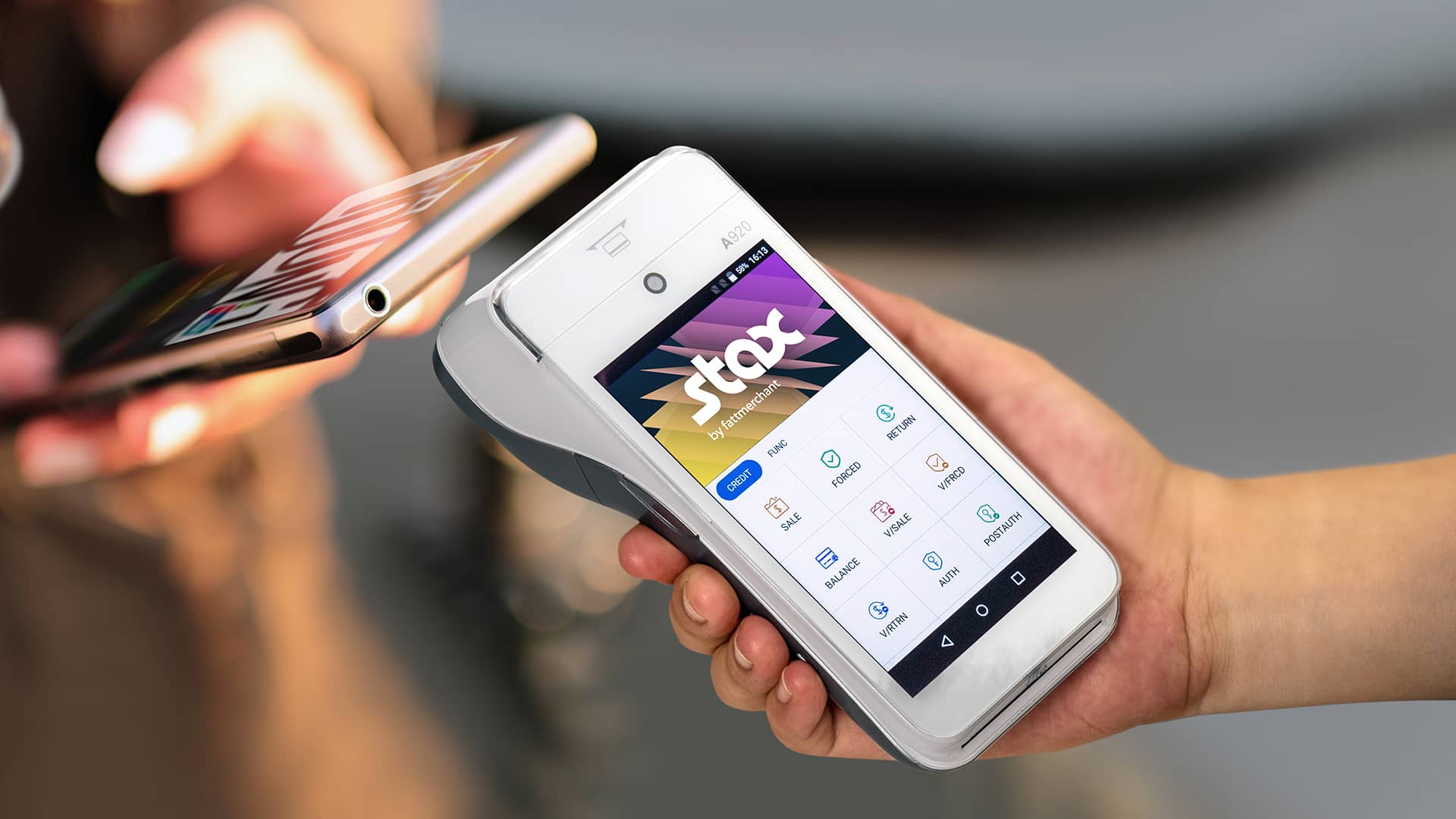
Mobile payment support allows customers to pay with their digital wallets (e.g., Apple Pay). Equally crucial is mobile point-of-sale (mPOS) support, which enables you to use mobile card readers or tablets (mPOS hardware) to accept payments from anywhere. Ensure the platform supports both of these, along with all card-not-present (CNP) methods like online links and virtual terminals.
Mobile payments work best with an integrated payment platform. Pairing up both of these features gives you a formidable payment system that can cater to all your needs.
Ensure cost effectiveness
All payment providers hold different charges for credit card processing. It is always important to research and compare pricing models to avoid overpaying. You must understand how the interchange rate (the fixed cost) is passed on to you.
In addition to platform service costs, you will find that most modern payment processing software comes with unique cost-saving measures. Automated features such as tip acceptance, real-time sales data syncing with accounting software, and automated invoicing are ways modern payment platforms can reduce manual administrative costs day-to-day.
This is usually possible due to the way these payment processors deploy their services. But it also has much to do with their backend systems. By finding a company that offers a payment processing platform with the key features that your business can directly benefit from rather than a generic, one-size-fits-all solution, you can make the most of your platform.
Stax eliminates this guesswork with our subscription-based pricing. We pass through interchange at cost with a 0% markup, ensuring you pay a predictable monthly fee instead of escalating transaction percentages.
Look for data analytics
Payment data analytics is yet another modern feature that has made its presence known in the past few years.
By using this powerful system to analyze your payments, you can get valuable insights into customer lifetime value (CLV), payment method preference trends, and successful payment attempt rates. This data helps you make effective, data-driven decisions, such as optimizing pricing strategy or identifying revenue leakage.
When paired with compatible processing services, this feature makes it simple for you to analyze the historical performance of your business locations. It also lets you judge the effectiveness of your specific offerings, such as your loyalty programs. This helps you make effective decisions that help you grow your business with ease.
Check for simplicity
You want to make sure that you use a platform that is simple and easy to use. When looking for the best payment processing system, there are a few things to consider in order to achieve the greatest simplicity. You must ensure that your adopted system is user-friendly, easy to use when accessing key features and tools, and adaptable when processing payments in various environments.
Simplicity also correlates to reliability. Having a system that is easy to navigate makes it possible to accurately locate tools almost instantaneously, therefore decreasing the amount of time spent on insignificant tasks.
Simplicity and intuitive design are critical for sustainable long-term efforts. Consequently, working with a complex user platform will negatively impact your business’s efficiencies, revenue, and customers. As your company continues to mature and expand, it is essential to have a system that will adapt to you, as well as your expected growth and changes.
Check for digital security measures
Last but not least, you must check each system for compliance with key security measures.
Any expert payment processor will facilitate complete compliance with the Payment Card Industry Data Security Standard (PCI DSS). Crucially, look for platforms that utilize tokenization and secure APIs to significantly reduce your compliance scope and liability, ensuring you never handle or store sensitive card data.
This compliance ensures that your payments are processed via exclusive, secure channels. Key to this security is tokenization, which replaces sensitive card data with a secure, non-sensitive identifier (the “token”). This feature is fundamental to PCI scope reduction and enables safe card-on-file storage.
Make sure that you take the time to discuss security with your preferred provider before you sign up for their services. This way, you can ensure your business is safe from any liabilities.
Conclusion
At Stax, we offer secure, modern payment solutions that may be a perfect fit for your business. Whether you need mobile payment solutions or POS credit card processing, we can fulfill all your needs. To learn more about our state-of-the-art payment processing solutions, or get a custom savings quote, reach out to us at Stax today.
You might also like: Payment processing platform and data analytics to boost your business
FAQs about payment processing platform
Q: What is a payment processing platform?
A payment processing platform is a system that facilitates the exchange of funds between customers and businesses. It allows businesses to accept various forms of payment, including credit cards, digital wallets, and mobile transactions.
Q: What are the key features to look for in a payment processing platform?
The key features to look for in a payment processing platform include integration with other business tools, support for multichannel payments, mobile payment support, cost-effectiveness, data analytics capabilities, simplicity and ease of use, and robust digital security measures.
Q: Why is integration important in a payment processing platform?
Integration is crucial, as it allows the payment platform to work in tandem with other key business tools, making payments faster and more efficient. It eliminates the need for invoice reconciliation and redundant data entry, saving time and improving efficiency.
Q: What are omnichannel payments?
A true omnichannel platform unifies all payment streams (in-person, online, mobile, invoice, recurring) into a single system. This is crucial for simplifying reconciliation, providing a seamless customer experience, and ensuring all data is tracked in one place.
Q: Why should a payment processing platform support mobile payments?
With the evolution of business models and the need to go cashless, mobile payments have become a necessary feature in the payments market. They allow businesses to accept payments from anywhere and without a physical card, enhancing flexibility and convenience.
Q: Why is cost-effectiveness important in a payment processing platform?
Different payment providers charge different fees for credit card processing. Researching and comparing these charges can prevent overpayment. Moreover, modern payment processing software often includes cost-saving measures, such as automation and synchronization with accounting software.
Q: How can data analytics enhance the effectiveness of a payment processing platform?
Data analytics can provide valuable insights into business performance and customer perception, allowing businesses to make effective decisions for growth. This feature simplifies the analysis of the historical performance of business locations and the effectiveness of specific offerings like loyalty programs.
Q: How does the simplicity of a payment processing platform impact its usability?
A simple and easy-to-use platform allows for quick navigation and access to key features and tools. It also adapts well to various environments, making payment processing more seamless and efficient. A complex platform, on the other hand, can hinder efficiency and negatively impact revenue and customer satisfaction.
Q: What security measures should be in place in a payment processing platform?
A reliable payment processing platform should comply with the Payment Card Industry Data Security Standard (PCI DSS) to safeguard customers’ financial data. Other security features such as Transport Layer Security (TLS) and tokenization for encryption are also crucial, ensuring that payments are processed via secure channels.
Q: What factors should be considered when comparing different payment processing platforms?
When comparing different payment processing platforms, factors to consider include the range of features offered, the cost for services, the simplicity and usability of the platform, the integration capabilities with other business tools, the types of payments supported, and the security measures in place.


